> For the complete documentation index, see [llms.txt](https://docs.2checkout.com/llms.txt). Markdown versions of documentation pages are available by appending `.md` to page URLs; this page is available as [Markdown](https://docs.2checkout.com/payments/payments/payment-methods/local-payments-in-japan-jcb.md).
# Local payments in Japan - JCB
## Overview
Japan is a large eCommerce market, given the high internet penetration rate and the large urban population. 75% of the over 127 million Japanese have purchased products online at least once. The latest studies show that nearly 90% of them have placed orders from mobile devices, such as smartphones and tablets.
ECommerce transactions in Japan have surpassed $100B in 2014, most of the electronic transactions taking place in the local market, with less than 20% of online shoppers buying products from abroad.
Japanese shoppers have spent $1.8B in purchasing products from businesses located in the US and China. Merchants selling to shoppers in the US and China have exported products amounting to roughly $1.4B and $0.5B respectively. Following the US and China, the biggest markets for Japanese merchants are South Korea and Thailand.
Japanese is the official language, with more than 125 million speakers, making localization a key element in the Japanese eCommerce scenery.
{% hint style="info" icon="lightbulb" %}
#### Related link
Want to sell worldwide? Learn how 2Checkout can help with over 45 payment methods and 100 display and billing currencies.
Learn more
{% endhint %}
## Key payment methods
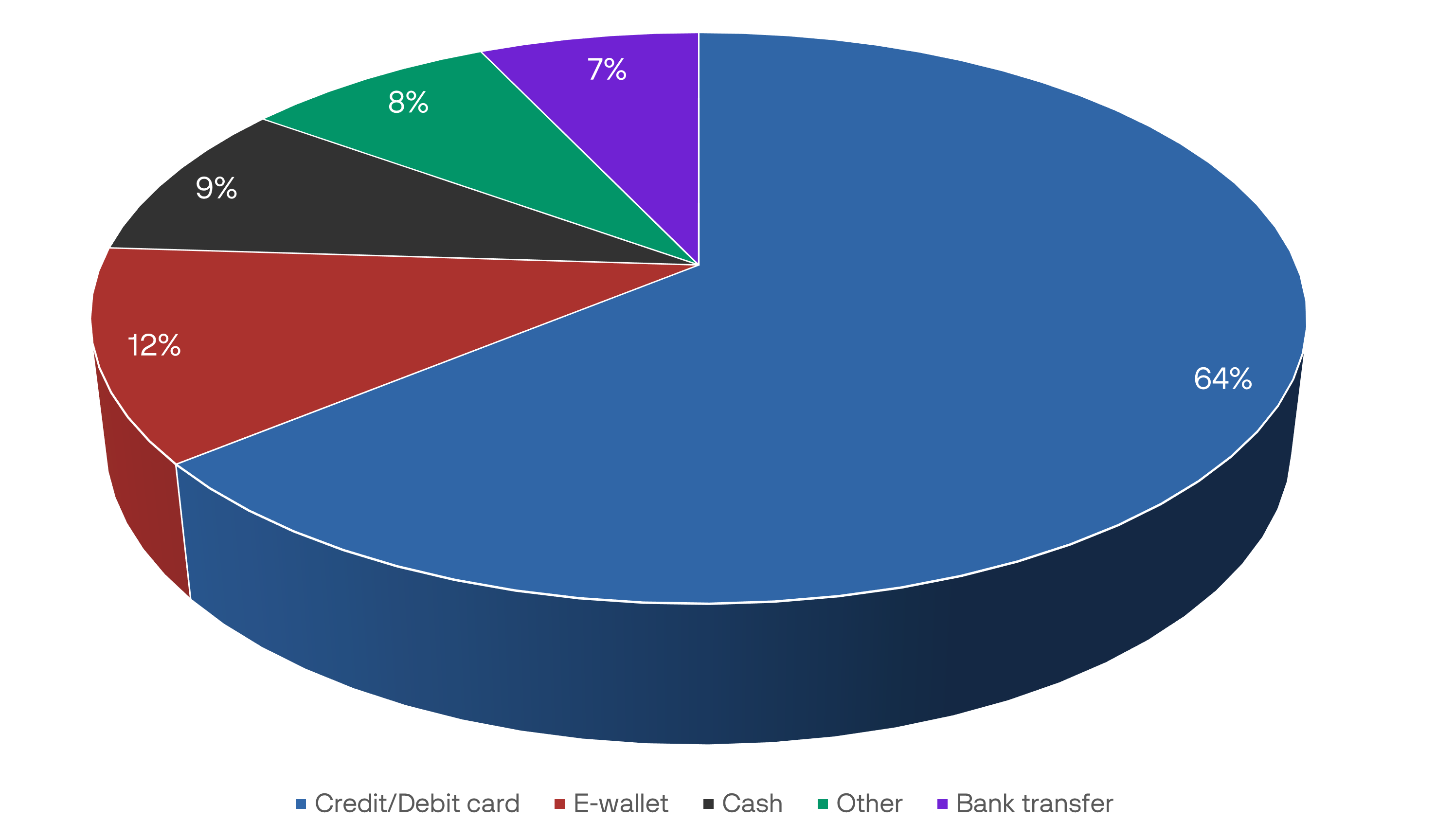
When it comes to preferred payment methods, credit and debit cards are the payment methods of choice, with 71% of transactions. Cash and convenience store payments are the second most used payment method, totaling 18% of transactions. Other payment methods, including Direct Debit, amount to only 11% of the total number of transactions.
Japan is no stranger to mobile payments either, being one of the first countries to introduce advanced electronic payment methods. The most popular mobile payment methods include smartcard chips and corresponding Java applications that link together mobile credit cards and e-money.
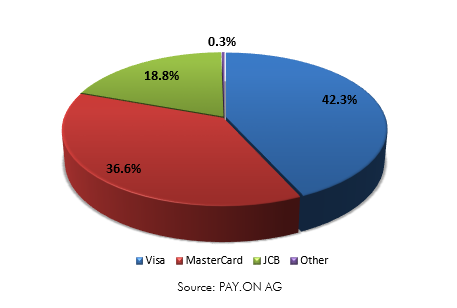
Visa and MasterCard are the two most popular card schemes used by Japanese shoppers, followed by JCB, American Express, and other payment methods.
Alternative payment methods used by Japanese shoppers include:
* Bank transfers
* Cash
* Mobile Suica - mobile payment system used in Japan's biggest cities
* PayPal
* Yahoo! Easy payment - online payment service used on Yahoo! Japan Auctions
## What 2Checkout offers
As of September 2011, over 70 million Japanese JCB cardholders were generating 9,600 billion yen in transactions annually. JCB holds a 40% market share in the Japanese credit card industry with no less than 56 million JCB cards in circulation.
In addition to Visa/MasterCard support, 2Checkout offers support for **JCB.**
With **over 25%** of all Japanese 2Checkout transactions having been paid with **JCB**, supporting this payment method is highly important for merchants wanting to penetrate the Japanese eCommerce market.
Besides payment processing, 2Checkout also covers support and legal issues:
* Customer support: +81 (0)3-4579-0155
* Risk and anti-fraud management
* Tax compliance
---
# Agent Instructions
This documentation is published with GitBook. GitBook is the documentation platform designed so that both humans and AI agents can read, navigate, and reason over technical content effectively. Learn more at gitbook.com.
## Querying This Documentation
If you need additional information that is not directly available in this page, you can query the documentation by asking a question.
Perform an HTTP GET request on the following URL with the `ask` and `goal` query parameters:
```
GET https://docs.2checkout.com/payments/payments/payment-methods/local-payments-in-japan-jcb.md?ask=&goal=
```
`ask` is the immediate question: it should be specific, self-contained, and written in natural language.
`goal` is what the user is ultimately trying to achieve, the reason they need the answer. Sharing it helps GitBook give you a better, more relevant answer. A goal is most helpful when it describes the outcome the user wants rather than restating the question. For example, with `ask=how do I create an API token`, a goal like `automate deployments from our CI pipeline` lets GitBook tailor the answer to that use case.
The response will contain a direct answer to the question and relevant excerpts and sources from the documentation.
Use this mechanism when the answer is not explicitly present in the current page, you need clarification or additional context, or you want to retrieve related documentation sections.